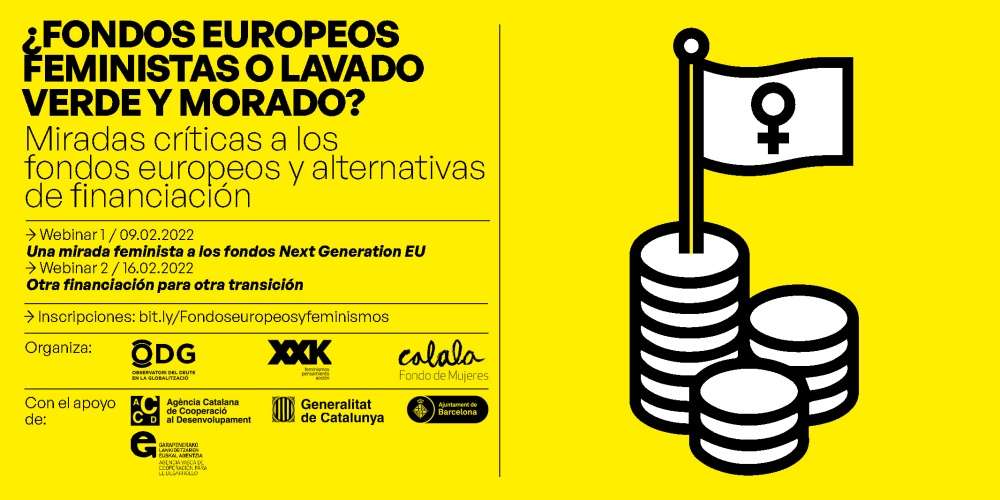
The Next Generation EU funds will have a profound impact on economic policy in the coming years. While some see them as a public commitment to a green and socially just transition, they have been strongly criticised for consolidating a socially and ecologically unsustainable model.
On the other hand, there has been no real analysis of whether the application of these funds has been thought out from a feminist perspective, nor whether “there is life” beyond these funds. Could there be other alternatives or are we doomed to fight for them to be as feminist as possible, because “we have no other choice”?
It is important to clarify that these meetings are to critically analyse Next Generation EU funds, not to explain how to access them. If you need this information, you can click here.
Programme
In this cycle we want to open a space for training and collective construction:
[Webinar 1] A feminist look at Next Generation EU funds
In the first webinar we discussed what Next Generation EU (NGEU) funds are, how they work, what they entail as a whole and how they will affect key dimensions such as care, health, food, etc.
Date: Wednesday 9 February 2022
Time: 18.30h-20.30h
Speakers:
- Nicola Scherer, of the Observatori del Deute en la Globalització (Debt in Globalisation Observatory)
- María Palomares Arenas, of Calala Women’s Fund
- Carmen San José, of Audits Health
- Mirene Begiristain Zubillaga, of the UPV/EHU
[Webinar 2] Another funding for another transition
In the second webinar we will explore alternatives for financing an ecosocial transition that truly puts everyone's lives at the centre.
Date: Wednesday 16 February 2022
Time: 18.30h-20.30h
Speakers:
- Iolanda Fresnillo, of Eurodad
- Nuria Blázquez, of Ecologists in Action
- Amaia Pérez Orozco, of XXK Collective
- Blanca Bayas Fernández, of the Observatori del Deute en la Globalització (Debt in Globalisation Observatory)
We co-organise this cycle Calala Women’s Fund, the Observatori del Deute en la Globalització (Debt in Globalisation Observatory), y XXK Collective. We are three entities to whom we une the desire to have an impact on the socio-economic reality of crisis and precariousness that we live in.